
Here is how to calculate car rental rates in one line: multiply the daily rate by the number of billable days, then add driver cost, extra kilometres, fuel, delivery, extras and tax. Leave the refundable deposit out. Write each line down before you accept a quote, and the amount you pay at handover will match the amount you planned.
The trouble is that a quote usually arrives as one number, such as "Rs. 5,500 per day", and everything else shows up later. A driver’s shift ends and overtime starts. The car comes back with less fuel than at handover. A kilometre cap is passed. A 3-day rental that looked like Rs. 16,500 ends far above that, and you cannot tell which line caused it.
This guide takes you through four steps, each with a formula and a worked figure. The examples use real Karachi rates from Rehan Rent A Car, which has rented self-drive and chauffeur-driven cars in the city since 2012. The method works with any rental company, so you can use it to check every quote you receive.
Why the quoted daily rate is not your total
The quoted daily rate is only the base of your bill, so a correct calculation builds the total from separate lines. Each line answers one question: how long, how far, who drives, which extras, how much tax. When you price them one at a time, no charge can hide inside the total.
The formula in one line
Use this structure for any rental, from a one-day errand to a full month. Replace each item with the figure from your quote, and set a line to zero when it does not apply.
Total cost = (Days x Daily rate)
           + Driver cost and overtime
           + Excess kilometre charge
           + Fuel
           + Delivery or drop-off fee
           + Extras
           + Tax
           - Discounts
The refundable security deposit stays out of this formula. A deposit is not a cost, but it is cash you must have ready. For self-drive at Rehan Rent A Car it is Rs. 25,000, returned within 7 days after the vehicle comes back and is assessed.
Build the total from separate lines, never from the headline daily rate.
What to gather before you start
You cannot fill in the formula without a few facts. Collect these before you ask for a quote, and the company can answer every line in one message.
- The exact vehicle and model year, since rates differ between a Suzuki Alto and a 2018 Corolla.
- Self-drive or with a driver.
- Pickup and return date and time.
- Your expected total distance and route.
- Whether the rate includes fuel, delivery and tax.
- Your documents. Self-drive at Rehan needs a CNIC, a valid licence held for at least 1 year, and the deposit.
Step 1. Multiply the daily rate by billable days
Multiply the daily rate by the number of billable days, and confirm how the company defines a day. This is the largest line in most rentals, so a mistake here costs the most.
Count billable days correctly
Most companies count 24-hour blocks from the pickup time. If you collect a car at 9 am Monday and return it at 11 am Wednesday, you have used two days plus two hours, and that can be billed as a third day. Ask about the grace period before you book.
Chauffeur-driven bookings count differently. At Rehan, a standard 10-hour shift is included in each day, with overtime charged beyond it, so a day means a shift and not a full 24 hours. For a worked line, a Corolla GLi Automatic 2018 at Rs. 5,500 per day self-drive, rented for 4 billable days, gives 4 × 5,500 = Rs. 22,000.
Agree on what counts as one day before you multiply anything.
Compare daily and monthly rates
If you need a car for more than three weeks, test the monthly plan against the daily rate. A Corolla 2018 automatic costs Rs. 5,500 per day on the daily rate and Rs. 1,35,000 on the monthly plan, which works out to Rs. 4,500 per day over 30 days. Dividing 1,35,000 by 5,500 gives 24.5, so the monthly plan wins from day 25.
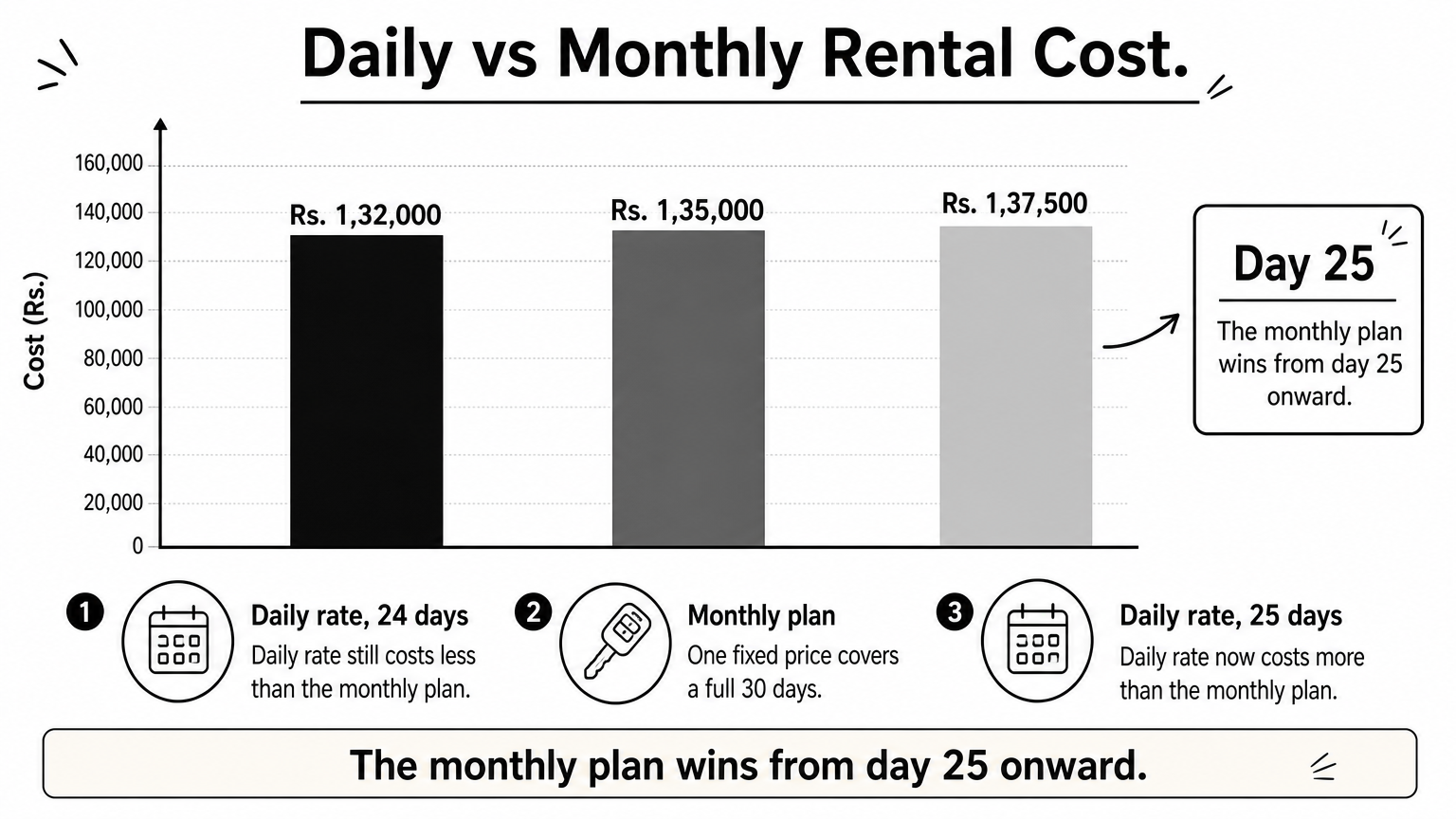
| Days needed | Daily rate total | Monthly plan | Cheaper option |
|---|---|---|---|
| 7 | Rs. 38,500 | Rs. 1,35,000 | Daily |
| 14 | Rs. 77,000 | Rs. 1,35,000 | Daily |
| 24 | Rs. 1,32,000 | Rs. 1,35,000 | Daily |
| 25 | Rs. 1,37,500 | Rs. 1,35,000 | Monthly |
| 30 | Rs. 1,65,000 | Rs. 1,35,000 | Monthly, saves Rs. 30,000 |
The monthly rate also includes routine maintenance, theft and snatching cover, and free delivery in Karachi. If a company quotes a weekly rate instead, divide it by 7 to get a per-day figure you can compare.
Step 2. Add mileage, fuel and delivery
Add three costs that depend on distance: excess kilometres, fuel, and delivery or one-way charges. Each one is easy to calculate once you have the quoted terms.
Excess kilometres
Ask whether the daily rate has a kilometre cap and what each extra kilometre costs. Then use this formula: Excess charge = (Total km − Days × daily cap) × rate per excess km. Suppose a quote allows 150 km a day at Rs. 20 per extra kilometre (illustrative numbers only). A 3-day rental allows 450 km, and driving 600 km costs 150 × 20 = Rs. 3,000 extra. If there is no cap, this line is zero, so ask directly.
Fuel
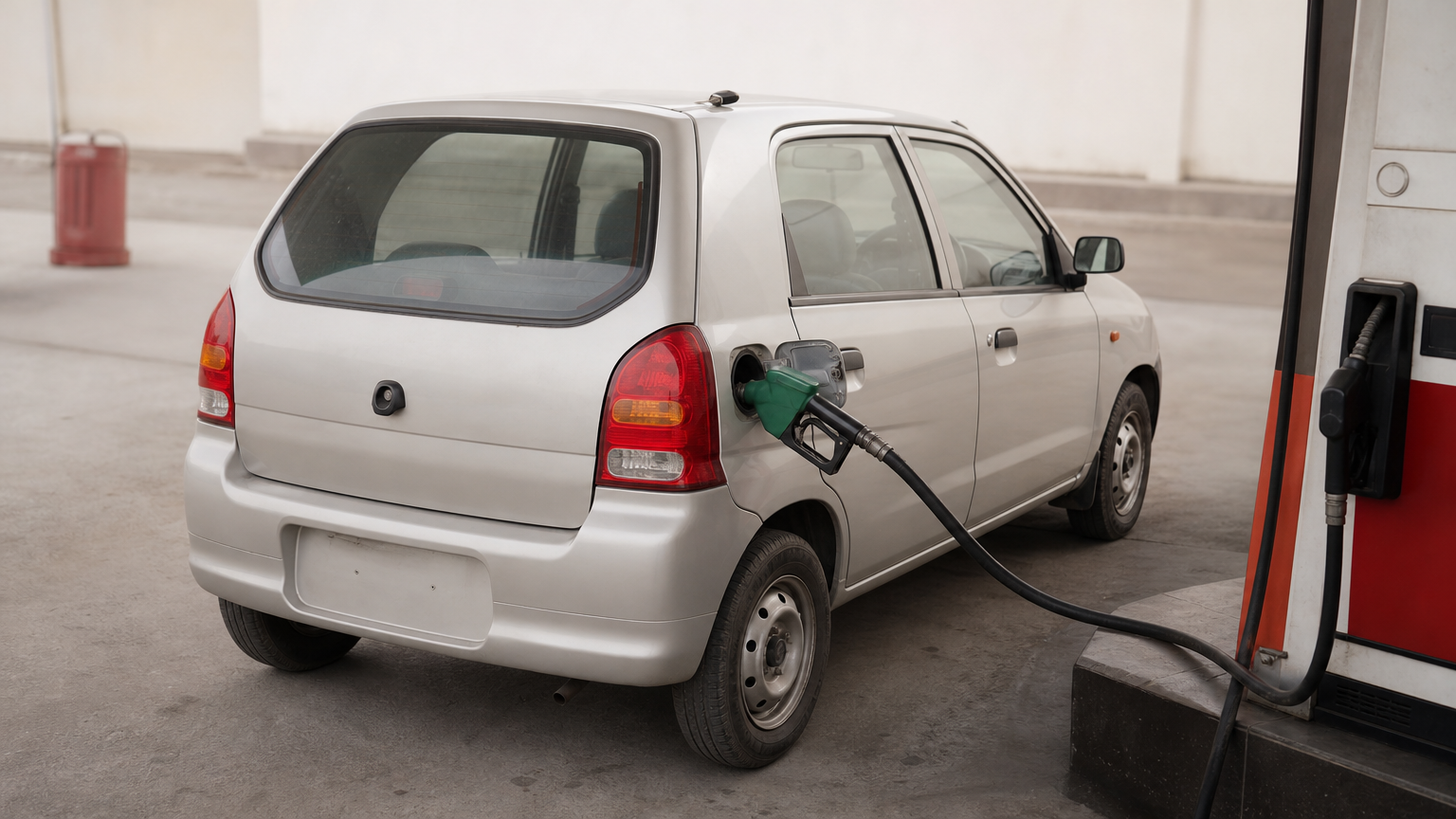
Self-drive cars at Rehan must come back with the same fuel level as at handover, so fuel is your cost. The formula is: Fuel cost = (Distance ÷ km per litre) × price per litre. A Suzuki Alto averages 18 to 22 km/L, so use 20. Driving 240 km uses 12 litres, and at an assumed Rs. 270 per litre that is Rs. 3,240. Use the pump price on the day you fill up. With a chauffeur, ask who pays for fuel before you book.
Delivery and outstation trips
Delivery inside Karachi can be a separate line, so confirm it. Rehan offers free delivery in Karachi on chauffeur and monthly bookings, and for self-drive the car is delivered to your home, office or hotel anywhere in the city. Intercity trips are priced per trip, not by daily rate. The Karachi to Hyderabad run is about 160 km on the M-9 Motorway, takes 2 to 2.5 hours, and starts from Rs. 8,000 one-way. For a return journey, ask for a return quote instead of doubling the one-way price, and add tolls.
Distance costs are three small lines, and each is zero only when the company confirms it.
Step 3. Add driver, extras, fees and tax
Add everything that is not the car itself: the driver, optional extras, fees, insurance gaps and tax. This is the step where totals drift most, because none of it appears in the headline rate.
Chauffeur cost and overtime
The driver cost is the difference between the with-driver rate and the self-drive rate. For the Corolla GLi Automatic 2018, that is Rs. 6,500 minus Rs. 5,500, so Rs. 1,000 per day. Spread over a 10-hour shift, that is about Rs. 100 an hour. Overtime is charged beyond the shift, so ask for the hourly rate and calculate: Overtime = extra hours × hourly rate. Plan your schedule against the shift length and you avoid most overtime.
Extras, fees and insurance gaps
Check each of these and set it to zero only when the company says it does not apply:
- A second driver, a child seat or other equipment.
- A young-driver surcharge, which some companies add for renters under 25.
- Airport pickup or drop-off fees and late-return charges.
- Cleaning or damage charges.
Insurance deserves its own check. Rehan’s monthly rentals include theft and snatching cover, but accident and collision damage is not covered, and the renter is fully responsible. Treat that as a cost you may carry, and ask what you would owe after an incident.
Tax and receipts
Ask whether the quoted rate already includes sales tax. The formula is: Tax = subtotal × the tax rate shown on your invoice. If you need to claim the rental for your business, ask for a tax invoice. Rehan is FBR-registered and issues tax invoices for corporate and long-term rentals. It accepts cash in PKR or bank transfer, and issues a receipt for every payment.

Ask for tax, extras and insurance terms in writing, because they are the lines that surprise people.
Step 4. Total it up and compare quotes
Add every line into a subtotal, apply tax, subtract discounts, then divide by the number of days to get your effective daily cost. That one figure lets you compare quotes fairly.
Worked example
The table below prices two 3-day rentals in Karachi. Fuel price and overtime rate are assumed for illustration, and tax is set to zero because the example quotes are treated as tax-inclusive.
| Line | A: Alto self-drive | B: Corolla GLi with driver |
|---|---|---|
| Days × daily rate | 3 × 5,000 = Rs. 15,000 | 3 × 6,500 = Rs. 19,500 |
| Overtime | 0 | 2 hours × 500 = Rs. 1,000 |
| Excess km | 0 (no cap) | 0 (no cap) |
| Fuel | 240 km ÷ 20 × 270 = Rs. 3,240 | Agree who pays first |
| Delivery | 0 (confirm) | 0 (free in Karachi) |
| Extras and tax | 0 | 0 |
| Total | Rs. 18,240 | Rs. 20,500 |
| Per day | Rs. 6,080 | Rs. 6,833 |
The Alto is quoted "from Rs. 5,000", so treat that as its lowest rate. The Rs. 25,000 deposit for scenario A is separate and refundable.
Compare quotes by effective daily cost
Divide each total by the days and compare those figures, not the headline rates. A car at Rs. 5,000 with fuel, a kilometre cap and a delivery fee can cost more per day than one at Rs. 5,500 with fewer extras. Get each quote in writing, such as by WhatsApp, which Rehan accepts alongside phone and in-person bookings. Use the same pickup time, distance and inclusions for every company, and you are comparing like with like.
Compare effective daily cost, not the headline daily rate.
Get your total before you book
To calculate car rental rates, build the bill line by line: days times the daily rate, then driver, distance, fuel, delivery, extras and tax. Keep the deposit separate, check whether monthly pricing beats daily after day 24 on a long hire, and divide the final total by the days to compare quotes.
You do not have to do the arithmetic alone. Tell the company your vehicle, dates, route and whether you want a driver, and ask for every line in writing. If you are renting in Karachi, you can request a written quote from Rehan Rent A Car and check it against the formula above before you confirm.
Add Comment